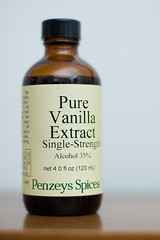
- Image by paul goyette via Flickr –alcohol extract
Herbal extracts are made from herbs and alcohol. Alcohol has the effect of removing essential oils from the plant material and releasing them into a liquid solution. Essential oils are the substances that give herbs their characteristic aroma and flavor. Extracts are used in the kitchen for flavoring foods and beverages.
Vanilla extract is probably the most commonly used extract. It’s part of countless desserts and baked goods, as well as a flavoring for hot and cold beverages. Lemon extract, orange extract and almond extract are a few other commercial extracts used in cooking and baking. Extract flavors are very concentrated, so only teaspoon amounts are required for most recipes.
In preparing these commercial extracts ethyl alcohol, or ethanol, is used to take out “the essence” from the source material, like vanilla beans, lemons, oranges or almonds, and release the essential oils into a liquid solution, called the alcohol extract. The alcohol extract is a solution of the essential oils and alcohol. Most commercial products are diluted to about 35% alcohol, but quite concentrated in flavor. Alcoholic extracts may also be called tinctures, but that is term used primarily with herbal extracts used in herbalism and aromatherapy.
Alcohol is very efficient in extracting essential oils from plants. Liquids other than alcohol can be used for extraction depending on the purpose. Commercially, glycerin is used to make alcohol-free extracts and alcohol-removed extracts, which are called glycerites. For alcohol-free extracts glycerin takes the place of ethanol as the solvent. Alcohol is not used in any part of the process in making alcohol-free extracts.
To produce an alcohol-removed extract an alcohol extract is produced first, then glycerin is added and the alcohol is driven off with heat. The resulting product may have very small amounts of alcohol left over from the extraction process, so it technically can’t be called an alcohol-free product.
It’s easy to make your own herbal extracts in your own kitchen. All you need is the plant material, some high-proof, non-flavored vodka or straight ethanol, and a jar with a tight-fitting lid. Pint-sized mason jars work well for small quantities.
Chop the herbs finely and place in mason jar. Fresh herbs will work the best, but dried will suffice. Don’t use powdered herbs as they will be hard to strain out of the resulting liquid. Pour the vodka over the herbs to cover them and seal the jar. Shake the jar to mix the contents and place it in a dark cupboard. Leave the jar in the dark for a month or more, shaking the contents every few days. Dried herbs will soak up some alcohol, so you might have to add a little more alcohol in the first couple days to make sure the plant material is totally covered with the vodka.
After the month of soaking open the jar and strain the contents through cheesecloth into a clean container. When the liquid has completely filtered through the herbs, wring the cheesecloth to squeeze out the last drops of the extract. Pour the extract into small jars using a funnel. Seal the jars with tight-fitting lids and store them in a dark cupboard. The shelf life of these herbal extracts is three to five years, so share them and enjoy.

Thank U for presenting and describing the extract making process. it is great guidance for me.
Please do explain from your experience Vodka or 35% alcohol or glycerin ins better for extracting the maximum properties.
with regards Raj
Hello Raj,
Extracting properties from plant materials can be accomplished with all the solvents you mentioned (Vodka or 35% alcohol or glycerin) and the choice may depend on what is available to you most readily. The higher strength alcohol works better than 35% alcohol for extracting purposes. Once the essence is extracted with pure alcohol it can be diluted to 35% for use.
Alcohol is much more widely available in my location, so that is what I would use for extractions instead of glycerin.
Good luck and let us know how it works for you!
dakua ni mo ug nawng
what is the solution of the kitchen materials and give the characteristics also
Hi Baby Jean,
For kitchen materials we use vodka for extracting, but you could use plain ethanol instead. In U.S.A. we can purchase alcohol – the kind for drinking – at a liquor store. So, you’ll need the dried herbs, vodka, mason jar with lid, strainer or cheesecloth/material, and small jar with lid for keeping the extract. A small funnel would be nice for transferring the extract to the keeping jars.
I’m curious which herbs you’ll be extracting, so let us know.
Good Luck!
Thank you for the directions on how to make herbal tinctures, it is amaising. How long would an extraction of shaga mushroom boil in water with just 10 % of alcohol can last without going bab, and what aditive can I use to preserve it longer ?
Hi Maria,
We don’t mess around with mushrooms very much, so I’m sorry I don’t have any advice for you in making a mushroom tincture. The alcohol will act as a preserving agent, but the strength should be a lot stronger than 10%.
Good luck!
i’ve been making my own extracts and practicing herbalism for many years, however, i would like to make some alcohol-free extracts to treat my infant. i’ve considered infusions, but i’m so busy as first-time mother that i need something that has a longer shelf life. is there a way to make the alcohol-free extracts sold in stores from my own home? can i make my own glycerite-based extracts, and if so, how?
Hi Brecca,
For simplicity I think I’d stick to infusions, but I can’t give advice on how to treat an infant, or anyone else for that matter! Hopefully baby won’t need too many treatments anyway.
I’ve never made my own glycerin-based extracts and doubt it’s worth the trouble. You’d have to start with the alcohol extract and mix that with glycerin and then heat the mixture to drive off the alcohol. The relative amounts of liquids and the heating time and temperature would have to be worked out for each kind of extract.
I’m curious what kind of infusions would you use on an infant?
hey herbie,
I am going to make a herbal extraction with three different types of herbs just wandering if it is ok to put more than one herb mixed with alcohol at one time? Or do I have to extract each one seperately then add it together at the end?
Thanks
Hi Kendal,
I’m curious what herbs you’re extracting, but no it shouldn’t make a difference if you extract more than one herb at a time. You might have to experiment with the proportions of each herb because the essence of some herbs may be more easily extracted than others. Let us know how it works for you!